Showing posts with label musing. Show all posts

Thursday, August 13, 2009

Random conversation

"Read this", F showed me a lengthy pdf file, with half serious authoritative voice.
It was a preface to a book, in Chinese.
"Why?" I'm confused, "I've had enough dealing with editors."
"My Mom asks me to read", she continued, "but I'm hoping you can read it and then tell me what's it about."
I'm speechless.

Half a minute later, randomness picked up again.
"My Mom would love to read your writing." - Apparently, she wanted to stick with the Mom thing today.
"It's the first time I hear of it" - I would have none of it.
- "I told her you were always busy"
- "True, true."
- "I bet you can't write in Chinese either."
I was in searching of words again.
"Seriously, write one, she would love to read it," F adds emphatically, "but she reads only Chinese. Are you the sage one? Write."
- "But, but...I don't have time."
That deterred her for just five seconds. "Aren't you write in Chinese and have random conversation with random people online all the time?"

That's when I remembered this space - to add more random staff for random people.

Related Content of This Rocking Post

Tuesday, March 24, 2009

Cherry Blossom and What not

It's not about the Japanese restaurant I used to eat out. It's the latest internet buzz of public debate in China. A twosome of mom and daughter was chastised and booed away by students of Wuhan University while posing for photos with cherry blossom, wearing Japanese Kimono. And public debate ensues.

Cherry Blossom and Kimono make great photo ops, since Japan is known as country of cherry blossoms. The beautiful backdrop of Wuhan University campus provides an enticing make-do for those who can't afford a trip to the east. (*Blossom forecast for D.C. is currently at April 1st.) Unfortunately Wuhan is also a city endured intense battle during Japanese invasion in WWII, and the animosity still runs high for a host of historical reasons. For this very reason, the university has a standing regulation that prevent students to pose with kimonos during the blossom season to ensure public safety. The poor mom and daughter wouldn't be able to hang the "same as there" picture in their sitting room, but good thing no one is hurt.

Consider what has been fueling the internet in the U.S., from AIG bonus scandals to newest bailout plans, life is relatively good in China if unpleasant treatment by radical students can cause public buzz. American press is so preoccupied by domestic messes that some border hot-spots in South China sea and skirmish in Tibet have not generated much fanfare.

However, it's one thing to grab the chance to preach forgiveness, and promote individual rights; it's quite another to stretch it to something far beyond. China is quite unique, with its political system and all - I busted a chuckle watching Obama prime time press conference when a reporter uttered "communist" in mentioning China - but some has gone far as to suggest Chinese are different people. Brainwashed is something you hear often. Perhaps they are wired differently emotionally - how can they hold their grudges for so long! It's not always the foreigners who suggest that. Some Chinese actually buy into that. Those folks, somehow, have the wonderful abilities of not counting themselves. Their crystal ball apparently doesn't inform them that there are loons and radicals everywhere, and public anger, even unfounded should be handled with caution. Not to mention, we are all from trees in Africa and are all going to die. Many AIG employees don't deserve the public anger that thrust their way, some even receiving threat mails, after all, many of them don't give out bonuses to themselves. But hey, people are angry.

Some folks have asked me if Chinese are easy to catch public fever. Idolization of Mao was often cited as evidence. I would cast my glance onto images of Obama on the sidewalk. I've seen his artistic contour on the sidewalks, on windows, on graffiti-filled bridges...you name it. If that's not idolization, I don't know what it is. People like to look up to someone in tough times, it's in our human nature. And, unlike Obama, who hasn't achieve anything significant so far, Mao actually achieved something.

Speaking of AIG and what America is up to, you can read by starting with this rolling stone article. You should get a pretty good idea of why the system failed, and why it's so difficult - it's often pick your poison - to fix it. The U.S. government is proposing using tax payer money, 1.3 trillion of them, to buy up toxic assets, with plenty room for corruption and back-dealing. That's precisely what the Chinese government did to their big banks and financial companies, circa 1998-2000, when they cleaned up balance sheet by absorbing bad assets. In addition, the U.S. seeks to seize too-big-to-fail firms, essentially turning them into state-majority-owned companies. Alas, that again, is precisely the Chinese system, where government controls key big firms and let the smaller ones swim on their own. What has this world turned into?

The doomsters would say apocalypse will arrive sooner or later. But I like Keynes' take: in the long run, we are all dead.

Related Content of This Rocking Post

Saturday, February 7, 2009

When idiots run asylum

Once upon a time, when we were young and restless - yes we did - we would touch upon these unpleasant political topics. My roommates would refer to Chinese intolerance, extreme in times like cultural revolution, as "asylum".

I had a slightly different take. "Asylum isn't that bad", I would inject my comments, "Asylum actually has its own rules. It depends on who is running it. It only gets that much worse when idiots, or inmates are running it."

That was a distant memory.

Then, when a friend talked about forming a group on Doudan, a Chinese social network, my reaction was that I would only form a group if it was about "the more you read, the more counter-revolutionary you become."

The phrase that later became the group title was an actually phrase from the Cultural Revolution. It was used as my contempt for Douban, and that unduly adulation of an "educated person". "Counter-revolution" was, of course, a word long buried in the history book. No one actually use it in everyday life, except, maybe, to jeer. My tenet of the group was that too much reading wasn't always desirable, it would stymie your original thinking, especially if you half-understand half-cooked ideas or facts. (In fact, that's my understanding of the original intent of the slogan.)

It was never an active group - as lazy as I am, you can always expect that. If I remember it correctly, the longest thread in the group was about "what would you request your daughter to read or not to read", with about 15 replies.

Fast forward to today. I got an email, informing me that the group was dismembered due to "violation of related laws and regulations". I believe it was due to Douban's voluntary compliance of internet censorship. Frankly, although not that I care, I can't quite make out what regulation it specifically violates. But the incident does reminds me of the conversation about asylum we had many many years ago.

I can't pinpoint whether the group was dismembered because of the asylum, or who runs it. But I would like to think I had a point.

Related Content of This Rocking Post

Tuesday, November 4, 2008

Trick or Treat

“Only Thing We Have to Fear Is Fear Itself,” that's a famous line from Roosevelt's first presidential speech. People wanted him, in comparison to hapless Hoover, to succeed so much that FDR had to hire many additional workers to handle mails from well-wishers.

The election will be over tonight. In the process, Palin went from the most popular governor in the country to be edified on SNL and a Tina Fey double. Republicans complained so much about media bias, it would probably put Chinese grievance in shame. That will be over also for her, win, or in the most likely case, lose.

We don't yet know what Obama is going to do, although we know his promises add up to 85 pages. Energy policy will probably be the first to gather enough political will to pass, although coal industry is already trembling in fear. Many Chinese are enamored with him, the way they saw a young, handsome, and energetic politician in Clinton, bill, that is. But his China policy is harder to differentiate. We only know he leans against more free trade, that he opposes NAFTA. Somehow, these issues were not even debated, not on the level of "lipstick on a pig" at least.[Speaking of trade policy, it used to be that American workers are more productive than others, so free-trade naturally favors the U.S., but that edge is rapidly waning, so does the appetite for free-trade. This election, more than anything, is a referendum on American people's acceptance in The U.S. new reality in the world. They don't worry about "the world leader" anymore than "give me the bread today". I wonder what Krugman thinks, since he was a strong proponant for free-trade in his more academic years.]

Oh, we also know that when slightly annoyed, while McCain has that it's-so-ridiculous-it's-laughable look, Obama has a more solemn what-the-heck-he's-talking-about look. As FDR could testify, personality plays a large part in a president's initial success.

The season of well-wish should not wait for January. Some will ask the "trick-or-treat" question, but the Hallowing is already over.

P.s. Here's another paragraph in the same FDR speech that is as interesting to read this time around:

True they have tried, but their efforts have been cast in the pattern of an outworn tradition. Faced by failure of credit they have proposed only the lending of more money. Stripped of the lure of profit by which to induce our people to follow their false leadership, they have resorted to exhortations, pleading tearfully for restored confidence. They know only the rules of a generation of self-seekers. They have no vision, and when there is no vision the people perish.

Related Content of This Rocking Post

Thursday, October 16, 2008

Sweet Organic Yogurt

My organic yogurt tastes sweet.

It makes me curious since I can't seem to find sugar in its listed ingredients. Upon further investigation though, I find the curiously worded "evaporated cane juice". "That's sugar" - my third grade science education saves me from puzzlingly over this myth for the rest of my life.

But I feel almost guilty. We are not suppose to think through these things. We like our yogurt organic and low-fat, we like sweet taste to help our happy digestion, but we don't like the word "sugar" on our otherwise healthy yogurt. "Evaporated cane juice", the geeky sound of it makes us feel so much better.

In Chinese idioms, there was a fable about "three in the morning, four for the evening". Once was a man who raised monkeys, he became poorer and had to bargain to cut their food. "I'd promise each of y9u three chestnuts in the morning and four for the evening." The monkeys were angry, "How can you treat us so poor!". "Then how about four in the morning and three in the evening?" the man re-offered. "That's much better", the monkeys were satisfied with his concession and jumped off triumphantly.

The modern day version of the story in the U.S. is probably presidential election. I don't know Barack Obama would keep his promises without raising taxes, nor do I know how McCain would balance his budget by cutting Pork Barrel Projects. No matter, all we care is whether Palin sounds stupid in interviews or eloquent in debates, or what "pro-America" really means. With Peggy Noonan weighting with mighty wordsmithship, is there any doubt this is more of a battle of words than anything else? Inside-out China lead to to an interesting article about verbage, but I see us more of prisoners of words. The challenge of the art is how to tell us we are in trouble without saying the word "trouble", or in McCains case, how to reassure the fundamental is sound without uttering the word "sound". Modern Homo Sapiens are not that different from old-time primates.

Certains words are to be avoided. While I'd love to be in that room to see the drama, no one in the media would utter nationalization or sociolization outright. If we were to sustain bailouts and revamps without otherwise changing our economic habit or raising our own taxes, we will sure shedding some of our burden to the next generation. But we don't want to hear that, we prefer to call it economic "smoothing". The chinese, being an old civilization surely understand the power of words, how else can you find naked capitalism basking under the glory of socialism? In a new market de-regulation, the China Security Overseeing Commitee calls the newly allowed short selling "security financing" (融券). My suspicion is that "shorting" would sound too much capitalist and unpleasant.

Give us our sweet yogurt, but never say sugar. You are in business.

Related Content of This Rocking Post

Saturday, September 20, 2008

Cows on the Street

What do China's milk incident and America's financial turmoil on Wall Street have in common?

A lot, actually. For starters, we are in a era of having to pay for someone else's responsibilities. The well behaved financial companies would have to pay for overly aggressive firms; if Washington's proposed bail-out, amounting to hundreds of billions of promised money, was to carry out, taxpayers are expected to pay for the greed of the money managing industry. The government would in effect control a huge stake in the financial industry, and in turn control a large chunk of the economy. Who says the U.S. is capitalist and China is socialist again? In China, well behaved milk producers are suffering the same as corrupt and negligent firms turn public confidence toward mil product to historical low. Diary farmers are also in a bind. As government rush to sort out the mess, for now, their daily output are only to be trusted to feed the flowers and plants.

Let's play the blame game. Washington blames greed on the Street. Traders blame stupid quants giving the wrong model. Quants blame business people feed their computer with the wrong data, and business people naturally blame banks. As banks blame on hapless people like you and me, you blame on your stupid neighbor who brought houses he couldn't really afford. The folk would undoubtedly point back to politicians in Washington. Oh, Merry go around. On the other side of the globe, consumers want to slaughter the diary giants. The diary producers would point fingers at farmers. After all, that's a easy target and it has always been first instinct of firms and officials caught red-handed to blame on them. The farmers would blame on the market and milk collectors that squeezed their profit, or everybody else who made their lives equally hard. Or, as the joke goes, they would blame on the cows, and let cows blame on grass feeds.

But you get the sense something systematically is wrong, in both cases. Oh, you can always point to greed for an answer - that's always there, but you also get the sense that the game wasn't set up right.

I read somewhere that mainstream Chinese economists - "mainstream" is a negative word in China when associated with experts - argue that China has established a bright, ideal system of localized competition, provinces, counties, and municipals competing against each other with their own industries and resources. That sounds fine and dandy, like a theory, at first glance; until you realize it involve the madness of competition of political power in the market place. Firm behavior when backed by local governments are like throwing two boxers into the ring with no judges. They would scratch and scrawl, taking turns to be judge themselves. When competition intensifies, they could literally choke babies - see the milk incident, and until then would central authority step in for a fix. Speaking of central authorities in China, they are finding out the new realities quick. Their usual ways to fix and control are lagging in this information age, so they always find a step behind the public's expectations.

The same can be said of the government in Washington.

After the dust settles, the too-big-to-fail firms on the Street will live on, the too-much-government-asset-to-fail dairy producers of China will have a happy new life. The market was up Friday, but don't mistake cows as bulls. If the Wall Street were raising cows, the situation would be described in Chinese joke parlance as "The cows remained calm," a joke with similar connotation of wacky Iraq minister in denial.

Related Content of This Rocking Post

Wednesday, August 20, 2008

Yin and Yang

Someone said it to me a few days ago, "It's a boring world, everywhere is the same. Men like to sensationalize in writing, women likes to indulge to dubious relationships."

Come to think of it as the reaction to Liu Xiang's withdraw swirled, that claim captured only half the truth. There were many "Literacy Youngsters" on douban who were quick to their sensationalist style, but there were also plenty of "Angry (disgruntled)" on Tianya forum.

Disgruntled is the yin to Sensationalist's Yang; radicalism goes both ways. But the Chinese press seems to forget the ancient Chinese wisdom. And Thomas Boswell of Washington Post may never understand.

Boswell, on the basis of some disgruntled internet posts, described the Chinese as inferior cruel mobs (remember Cafferty?) who piled on their fallen hero. The sudden drama of Liu Xiong's pull-out had wide spectrum of reaction across the internet. Most voiced support; some questioned whether pulling out was a pre-determined decision; others had a hard time understanding why it had to come down to a decision on the starting block.

Let's read some Olympics press coverage, shall we? Micheal Phelps got eight gold, and New York Times had a whole column dedicated to it, discussing whether that was the greatest Olympic achievement. We were all capable of enjoying the sensation. When I turned to Sina, it had a full special page dedicated to Liu's withdraw, trumping the eight-gold-treatment. The U.S. Had also someone who didn't finish the race, although not on the starting block. Trammell pulled his hamstring in the same round and had to pull up. He got mentioned by NYT only in passing in the article covering Liu Xiang. Lolo Jones, with her unique story, was sympathized in an article.
The media non-corporation award went to Tyson Gay. NBC reporters kept giving him cue on how he was injured leading up to the event, but he insisted he was fine, just "did not get it done". Flip to sina, there were reports that Liu was running 12.96, 12.98 before the race, or more precisely, withdraw. A CCTV reporter even mention she has inside information that Liu was running close to 12.80. The numbers varied. I didn't know which one to believe exactly. But nevertheless, "Beijing Olympics should have belongs to him", as the reporter proclaimed.

There had been enough media frenzy about Liu's tragedy, most unanimously sunny, or humane as someone liked to say. (I'm quite tired of seeing the word "humanity" in Chinese press nowadays, as if the China I've lived was inhumane backward doldrums.) Liu might be fallen, but "did not “lose.” Perhaps to counter charges from the likes of Boswell, there were even reported rumors that an order was given, forbidding the country’s news media from criticizing Liu. A hero was intact.

With all this "yang" in the official media, it was not surprising to find "yin" of different voices in unofficial forums. BBS itself had been the "yin" to the official media's "yang". Together, we had "qi" of a harmonious society - joking. But whether in support of sensationalized tragic narrative or being disgustedly suspicious, it was all in accord to "one world, one dream".

I have watched Liu Xiang four years ago. He was flamboyant on camera after the surprising win, but I liked it. It was spontaneity. And I marveled.

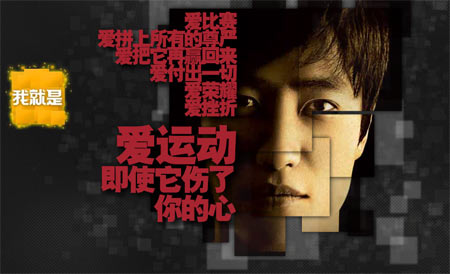
Now four years after, I felt the sadness watching him pulling out. Liu was not on camera immediately afterward, he issued an apology - it's not like he needed to. His apology came out the same time Nike tweaked its ad campaign featuring liu. The words on the poster read:"Love competition. Love risking your pride. Love winning it back. Love giving it everything you’ve got. Love the glory. Love the pain. Love sport even when it breaks your heart." I couldn't help but thought of the word: PR.

What about the "women likes to indulge to dubious relationships" part, you may ask? Well, isn't it obvious by now? The counterpart is that men are not courageous enough.

Related Content of This Rocking Post

Wednesday, August 13, 2008

Autopsy of a Media Storm

A story about double-act of singing on the opening ceremony was making rounds in the media and blogsphere. In pursuit of theatricals perfection, directors combined Lin Miaoke's stage appearance and Yang Peiyi's singing voice.

Most of the reports in the western media seemed to be based on an interview of the music director by the Chinese media. transcript shows

陈其钢:“对。也可以说这是最后一分钟的不得已的选择。因为我们经历了若干次审查,都是相当严格的。我们听过一次林妙可的录音,在现场放的,是在联排的时候。然后有各方面的人,尤其是中央政治局的领导,在听的时候,给我们提出了意见,说必须要改变。这是没有办法的”

which indicated Lin's voice was not good enough and had to be mimed by another voice. Whether he was telling the whole story was another matter.

While some reports got that fact straight, others totally missed boat. Chicago Tribune for example, reported as: "one member of China's Politburo revealed Miaoke had lip-synched the song, after the original singer, Yang Peiyi, was told she was not good-looking enough." Chen, who revealed news, was not political leader. the Tribune might not realize it was in conflict with its next line: "Chen Qigang, the ceremony's music director, had been asked last minute by the Politburo official to replace Peiyi with Miaoke, according to an interview with Beijing Radio."

Nevertheless, the "not quite" headline of "girl kicked out of ceremony performance at the last minute" because of "chubby face" and "Bucket/crooked tooth" had became the main theme of the story. I am not sure where journalists got the crooked tooth part. It sounded like their own interpretation by looking at the picture.

Time UK emphasized that theme by using headline of China banned child singer with crooked teeth from singing at opening ceremony. "Chubby-cheeked with crooked teeth, she was substituted at the eleventh hour by Communist Party officials desperate to present the best possible image of Chinese youth to a curious world. " it asserted.

Whether Lin's voice being subbed in the 11th minute or Yang being substituted, fact remained Yang did not get on the stage except her voice. Who said good looks and stage presence weren't "talent"? Jessica Simpson would probably agree.

Fake, is the predominant word used in headlines across UK press. Headlines such as China 'faked' awesome Olympic opening ceremony was already in place when it was revealed parts of the "footprint" show was not shot in real time. Maybe the Brits didn't know that was not made of secret. NBC mentioned it during the broadcast. Past TV productions, such as fire in the studio fireplace during the 2002 Salt Lake Games, was also generated digitally.

Fake might be an uneasy word, but perfection was always an illusion. Lest we forgot.

Guardian hedged their report by pointing the source to a translation by the China Digital Times website.

"We had been through several inspections - they were all very strict. When we rehearsed at the spot, there were spectators from various divisions, especially a leader from the Politburo, who gave us his opinion: It must change," said Chen.
In deed, by leaving out details such as it was Miaoke's voice they were listening at the rehearsal, that translation could lead to confusion conclusions. That's what you got by sending reporters who are not versed in the local language.

Whatever the source, British media finally found their controversial story about the opening ceremony. BBC called it the second "fake" story about the opening ceremony, and asked openly for comments whether this has damaged the image of the Beijing Olympic games. Its own tone was made apparent in its editing choice of comment to appear on the main page - a Beijinger comments: "If the stories are true, it is absolutely disgraceful and I am ashamed as a Chinese citizen."

It's understandable that British got extra mile from this story. London after all has to host the game in four years. As Telegraph put it:"it might now be easier for London to end the 'arms race' that requires every staging of the Games to be more spectacular than the last. "

In fact, the media storm was not broken first in the west hemisphere, Chinese media and blogs were seethed about the story first when the interview was first published. There was something about China and fake that struck a cord in people's mind. Some English language reports even cited Chinese message board writings in the initial confusing hours. Yes, that what journalism reduced to.

The stand-in singing is a result of complex social value system we have today. There is China's overwhelming desire for perfection; there is this film director who is famous for meticulousness in aesthetics; there is Eastern culture of "face value", there is also this today's "looks" obsessed culture - American or British or Chinese. Think of Audrey Hepburn singing to the voice of Marni Nixon. Although it should be pointed out that both girls get credit on both the ticket of the ceremony and DVD that is released, the concern of influence of adults value system - and what kind of system should it be - on the two girls is genuine and legitimate. Personally, I think the directors miscalculated the social amplification and should have simply used best vocal. That being said, some of the directions and tones of this media storm are not surprising. After all, controversies are relatively scarce on these Games, how else can the media be fed on.

Related Content of This Rocking Post

Thursday, August 7, 2008

Hundred Years

[Chinese Version]

China calls the coming Olympics “a hundred year’s dream”. To the Chinese, Olympics is clearly not only a sports gala and party festival. Incidentally, I’ve recently watched Matching to a Republic, a TV series of historical drama. With fifty nine episodes, and 40 plus hours spent on, it probably deserves some of my comments on the historical road China traversed.

Many of the trajectories of present day China can be traced back to hundred years ago. There isn’t much new under the bright sun.

(1)
Let’s start from a scene in a later episode. Sun Yat-sen, who was regarded as the founding father of Republic of China, tried to reorganize his party into a revolution party after he failed the Second-Revolution. At the time, the then president of the new republic, Yuan Shikai, was about to crown himself the emperor of a constitutional monarchy. Of the 11 governors declared as Nationalist Party member, only two supported his agenda in force. Attractive political ideals were no match for practical position in powers. Sun realized the paradox, that he needed more centralized power to achieve his political dream, a real republic. Political construction might get by with loose organization, but a revolution that didn’t have enough public base required authority. He began to encourage political purity and personal loyalty within the party.

Sun didn’t make his political dream a reality. Before him, Emperor Guanxu wanted to reform but lacked real power, Empress Dowager Cixi had the power but didn’t want the radical political reform, at least not while she was still alive. His follower, Chiang, who took a cue from Sun’s realization and took it to another totalitarian level, ran a corrupt government, but at least nominally united China divided by warlords. Mao’s party also understood the secret to survival and what it took to achieve things in China. It promoted ideological purity within party and believed in “Political power grows out of barrels of a gun”. It took only three years for them to win out the civil war. There is no revolution any more today, but the political belief lives on: that you need a degree of central power and authority to get things done in China, where average citizen isn’t informed or active enough of politics. Deng was also such a believer.

Second Revolution wasn’t unique to Sun either. Mao had his own second revolution - the Cultural Revolution. At least part of the motive behind Mao’s second revolution was the same as Sun’s, that he saw his political ideal was in danger, and that his New China was slipping back to the Old China. New bureaucrats were quickly reverting back just like old bureaucrats, and that conflicted with his vision of a strong China. Mao took a page from Sun. To experiment his vision of democracy and people’s power, he encouraged personal idolization of himself and increase his own authoritative power. It degenerated into a disaster. Later elitists inherited the authoritative part but scratched, or postponed democracy part.

The TV drama series stopped short of the Chiang’s era, probably because it was too close for comfort. But Chiang made an unnamed appearance in it. In one episode, a Japanese instructor pointing a finger at mud in a flower pot, said: “This small piece of mud can contain of a large amount of bacteria, hundreds of millions, as many as there any 4 hundred million Chinese.” An angry student went up to the lectern and retorted, “It must contain a hundred million bacteria, as many as the people in Japan.” That man was Chiang.

Ever since Xinhai Revolution, Sun, Chiang, and Mao, their ideology, personal style, and politics were very different, their understandings of the China’s reality and future differ, but they were all nationalist.

(2)
Matching to a Republic as a Chinese production of recent history has some refreshing improvements. Gone are stylized faces and ideological divides. In stead, it depicts historical figures as human and personal touches.

I’ve also witnessed some contemporary historical writing go to another radical extreme. Rewriting and redefining seem to be in fashion. It’s not surprising in the context of the world we live today. Overturning history, whether rightfully so or not, means at least the merit of independent thinking. It attracts attention, usually accompanied by commercial success. If it so happens that Napoleon fought Julius Caesar, or we interpret historical figure with our own modern minds, too bad. Dead people can not explain themselves.

George Washington was a slave owner. He only freed his slaves after both he and his wife died, in his will. But that’s not to say he was not “the greatest man in the world”. Chinese intellectuals at the time especially admired him for not declaring himself the new King of America. In truth, there was little political ground on the American colony for him to crown himself. And why would he anyway?Great leaders are charismatic and of great social conscientious, but they are not living not of their time.

Turning 180 too many times makes us forget where we come from and even where we stand now.

China has a strange tradition of overcorrection. History was dressed up like little school girl according to winds of overcorrection.

(3)
Overcorrection as an ancient political term deserves some interesting investigation. You see, correct as a verb has a natural authoritative, top-down tone to it, like the time God walked into the city of Sodom and decided to correct them, make it just.

To lead a nation as diverse as China, needs tremendous wisdom and courage. To take the shortcut of making a strong nation needs a degree of authority and central power. The problem is that in China, once the power is installed, it does not have the tradition of checking itself. Or that tradition has been lost. With that, came the revolution and subversion, and the more radical solutions in the pass hundred years or so. The question we have to pose to ourselves: does the approach matter even if it is the right thing to do? Where do we place the so called procedure correctness, and where to draw the line?

The central theme in hundred years of China’s political movements is primitively to make the nation stronger. Rights of people come second. Pragmatism has always had market in China. It fits with the tradition of “succeed you becomes the king, fail you becomes the vagabond” well. Political and ideological arenas are no different.

(4)
The modern history of China from hundred years ago started from wars, more precisely, from losing the wars. Since then, general attitude of Chinese toward political system was anxious and goal-oriented, primitively to hope to bring a stronger nation.
An 1876 NYT article said of Chinese “fear of any innovation and reform”. No, it was not describing the religious Tibet, which shall be described as Shangri-La and peace loving etc. Since then, Chinese has made their own conclusion about that piece of history, they flat out concluded: “to be backward is to be beaten.”

The deficiency of politics of which primary goal was to catch up with the world and make the nation stronger – not be mention it was spearheaded by a small population of new elite – was the lack of stability. Only when the population was modernized and learned how to comprise and manage the country through politic could stability be possible. People sometimes are used to all the responsibilities to the leaders and politicians, yet Confucius said: “I reflect upon myself three times a day.”

(5)
The TV drama gave great sympathy to most of the historical figures.

Empress Dowager Cixi was a steady political hand. Her temper might be fickle, but her ability to manage the Qin officials was unmatched. She even had the courage, or foolishness depending on how you see it, to declare war on all major Western powers. However, whatever she did or did not choose to do, she managed the country as if it was her property. Winning the wars would have been nice, but losing wasn’t too much of a disaster either. The burden of war retribution fell on the population, not her highness.

Lee Hongzhang, the last Qin statesman who was called “Bismarck of the East” by the West and once called traitor by the Chinese, devoted his life to China’s diplomatic relation with the world. However, his none-resistant policy was equally costly. He steered clear of the provenances under his governance clear of the military conflict even when the central power in Beijing was been traced out of the city. Once the war was lost, people under his governance couldn’t escape the bitter result either, they would also have to pay war retributions. Frankly, on one hand China was too big for the then imperialists to swallow; on the other, a defeated country has little to bargain for, great diplomatic skill or not. Lee wouldn’t make the slightest difference.

Yuan Shikai, the able politician whose personal ambition drove him to be the hero who ended the Qin monarch, but also doomed him to be one who wanted to become an emperor of his own. But as capable as he was, his Beiyang New Army didn’t register a victory or even a serious fight for the country. In stead, it became a bargaining chip of his own power.

Kang Youwei, the ambitious but impractical reformer who failed, was really the father of all “overseas democratic fighters”.

Chinese like to speak of “grand virtue”, loosely interpreted as fighting for the people, and “personal virtue”. But, grand virtue is sometimes hard to judge, it swings with political and cultural tides. Chinese also often speak of personal political ambition negatively. But ambition isn’t really sinister. The sad tragedy of all these historical figures of the last hundred years was that there wasn’t a system in place to align their personal ambition with the common good of the people.

Luckily, we average folks still have personal virtues to cherish with, especially with the ones close to us.

(6)
The success of the gradualism reform in China was largely praised around the world. Gradualism reform can be traced back to the experience of a hundred years ago. The more radical reform of Wuxu failed, but a more gradual approach later was largely successful.

The world today warily watches China as a “rising power”. Let’s not forget there was a period a hundred years ago the world warily watched China as a possible power, mistakenly we must say, reflectively. The prospect of a large population and vast market was simply attractive, then and now.

The debate started a hundred years ago continued into today: should China make foundation of Chinese wisdom but adopt Western knowledge? Or should China totally westernize, especially in the political areas?

I shall point out this is really a false topic. When enough people opened up to the modern knowledge, when enough people are wealthy and educated enough, when politics is no longer but designed by a small educated elite, people will reach a natural selection. Chinese or Western, does it matter? Moreover, the distinction between Chinese and Western may be water under bridge then. Culture is fluid.

Similarly, Chinese characteristic is a natural mark, not something you proclaim for, or design for. Proclaiming of ___ (feel free to fill in the blank) of Chinese characteristic is always suspicious.

(7)
Speaking of war and treaties, let’s look into a few. The first Sino-Japanese war of Jiawu was largely limited to the navy fights. The central government, the Qin court, was under menace. A treaty was quickly signed. No serious fight was staged. The Battle of Beijing by the eight-nation alliance saw an army of only teens of thousands, with a casualty of less than 2000. Many Chinese forces didn’t fight in the war. The New Army of Beiyang didn’t open a shot, and the South China stayed out of the conflict all together. Although the Boxers, agitators of the conflict, joined the fight, but it’s safe to say no “war of people” happened. To blame the loss of war and unfair treaty all on “to be backward is to be beaten.” seems to be overly simplistic. Fifty years after, facing another advance equipped United Nation army, Chinese forces didn’t loose ground.

It’s not surprising Western powers called the Chinese “loose sand” then. They had a point.

What the new People’s Republic really contributed to the Chinese wasn’t ideological ist, but the new found upward spirit and confidence in the society.

(8)
The Beijing Olympics is said by Beijing and foreign media as a landmark of integrating into the modern world. The process and exploration started more than a hundred years ago.

In fact, the shaping of modern China and its choices are always under the influence of the Western powers, including the worrisome nationalism. People in the West don’t often understand why China can not let go of the memories of more than a hundred years ago. But for Chinese, history from a hundred years ago directly influenced political choices of their nation every step of the way, and thus wired into their current life.

Many people have pointed out Chinese society is often restless. Such restlessness also started a hundred years ago. The history of being the invaded makes people less confident, makes the politics more radical.

If China could have waited the development of the country and its new social class entered the political scene, things might be different. But the international society then didn’t give China patience and time; the wars didn’t give China much time and choices.

Nowadays, the powers make a point not to burden the defeated countries with unbearable debt or too much unfair treatment. That’s an improvement. Lesson learned. But history has no what ifs.

(9)
Now that Beijing Olympics is finally here. For many, “a hundred year’s dream will be complete. Can we get the game start with, and finally get on other businesses?

Related Content of This Rocking Post

Monday, August 4, 2008

The Bird Nest is...Empty!

I have a friend who always tells me artists are big Huyou - the Chinese term for deceit. "The more famous ones are the bigger huyous" he would say, "they appeal on a higher level."

Bird NestNot sure how much his views had influenced me, but when NYT published an Interview of Ai Weiwei, an artist whose name is associated with the design of Bird Nest and a classmate of Zhang Yimou, I flocked to see what his huyou was. The NYT's blog called Ai "Bird’s Nest Designer", but a more proper term would be "artistic consultant". Although I guess he won't protest being called designer, only that he has an issue with Olympics, calling it a "pretend smile".

Q: What inspired you in designing the National Stadium? Can you describe the design process?

Ai Weiwei: The design concept for the National Stadium came from a complete “emptiness,” when Herzog & de Meuron and I were talking about the initial plan before we started on the actual design. We emptied our minds, which made it possible for us to find the best points from aesthetics and practicality. The rationale of the structure, its exterior and interior appearance, called for a maximization and unification of aesthetic functions and actual needs. The sense of totality was critical in the initial conception of the design. During the process, we were anxious and excited. We hoped to produce a language that possesses a unique form that is able to support many functional requirements. The entire design process was carefree and fun, it seemed very clear and obvious, free of any obstructions of traditional notions.

OK, so the design concept for the National Stadium came from a complete “emptiness”? What's inside emptiness? Does emptiness has emptiness? Is the steel beams emptiness? Aside form the usual cliches that follows, the whole answer leaves me feeling pretty...empty. Hmm, artistic talking, pretty huoyou.
Q: Are you going to the opening ceremony?

Ai: I’m not attending the opening ceremony, I’m not interested in it, and I haven’t received any invitation. If I need to be more clear on why I’m not willing to be part of the ceremony, it’s that I think it’s too far from the spirit of freedom. I’ve always thought of this ceremony as a product of government bureaucracy, rather than a natural celebration and expression generated among free citizens. I feel that there are too many regrets in this ceremony, which could make me unhappy.

Was it really "I’m not interested in it" or "I haven’t received any invitation."? Now I was really confused. Was he really trying to distance himself from the Olympics after he joined the design of the stadium and reaped financial and press gains? If not for the "designer" title associated with the stadium, few Chinese would have known his name. His double position was very much Chinese. Chinese intellectuals have a tradition of accusing others, say deploring the lack of free speech, and turning around doing exactly the same. All artists are expected to have an edge, but still...Can you say Houyou?

Ai went on to say people in a society that didn’t have democracy were not possible to get excited and cheer for the game - facts not withstand, and thus the term “pretend smile.” But by that time, I've lost interest in further reading.

For the record, out of all newly built stadiums, I like "the cube" the best.

Related Content of This Rocking Post

Friday, July 25, 2008

Will capitalism save virginity?

To believers of market, market will find a solution to everything. Will it save virginity - in China?

China was traditionally a conservative country in sexuality. We've had the likes of Xi Mengqing in old novels like The Golden Lotus and anecdotal stories about gayish princes, but mostly it's hush hush. As the capitalism first arrived when China began its "open and reform" program, sex was also a vocal point of personal freedom as debated subject, so much so that also all Chinese famous novalists at the time all included sex, sometimes pervert sex as part of their depition. Mo Yan, autor of Big Breast and Wide Hips, Su Tong, Jia Ping'ao were all among them.

Then there came Shanghai Baby, a euphoria novel of sex adventures, from which the calling "beauty writer" was born. BTW, the author was relatively tame and far from "beauty" before she made a name, from what I knew of her. And there was Mu Zimei, a blogger famous for publishing details of her many sexual encounters, led the sex revolution to the pinnacle. That's why stories like disco bunny comes as no surprise to the Chinese.

Now, a new wave of chastity is quietly making waves. Surprisingly, one of the force in this new found chastity is the raw and unapologetic Chinese style capitalism. As this Danwei translation of a South China Weekend story tells, while some young women are not try about using their sexuality to their economic advantage, others now see keeping virginity before marriage as an advantage in the competitive marriage market. In economics jargon, the market has reached an equilibrium!

The question then is why virginity is cherished and being seen as an advantage. That's the question I pose to my friend, who is also a Chinese.

"That's because Chinese males are deeply insecure about their sexuality. Having a virgin without prior sexual experience as a wife helps them not being exposed sexually."

She is equally unapologetic.

Related Content of This Rocking Post

Saturday, July 19, 2008

Murky Love Economics

The thing about life is that its unpredictable and doesn't subject to one single rule. I would always be aware of the "universal truth" unearthed. Many ideas are inspiring or illuminating. But more often than not, there's always qualifications, in small prints, that need to be noted.

Let's take a look at some of the main points of this very interesting and well written piece by Ben Stein: Lessons in Love, by Way of Economics.

In general, and with rare exceptions, the returns in love situations are roughly proportional to the amount of time and devotion invested. The amount of love you get from an investment in love is correlated, if only roughly, to the amount of yourself you invest in the relationship.
Oh what the statistical panacea. What about business failures? What about concept like sunk cost, stop-loss in economics?
High-quality bonds consistently yield more return than junk, and so it is with high-quality love.
The problem is, as we know in the investment world, junk/investment grades can be down or up graded, reversed in a whim, even with name brands. GM might look all mighty blue chip in a day, and slip to junk status to the next. Sometimes, even professional graders - read, Moody's etc - can't provide accurate grades in time, otherwise we won't have subprime crisis. How do you expect we to excel in love bonds in which most of us are amateurs? The negative situation rings more true:
the absolutely surest way to ruin your life is to have a relationship with someone with many serious problems, and to think that you can change this person.
Mr. Stein further urges us,
Research pays off.
Not necessary. Some qualifications are required. Too much research makes you a timid investor, and too much time in research doesn't necessary gives you competitive edge in a competitive market where everybody else does the same. And we all know researches don't earn best money in the finance world, they end up being hired by the more competitive personalities.

Ok, if you think this is all too picky, I agree. However the gist of the stories is, that theory is better at rationalize than practice, and that economics is a science that cares about outcomes in aggregates and statistical results, but love is a very personal thing. While Economics can sweep exceptions as anomalies, personal pains can't.

In the end, we can at least agree that love, like many other aspects of life, needs to be "managed".

Related Content of This Rocking Post

Monday, July 7, 2008

Here comes communists

Poster on the picture left says "No service for communist bandits", and the board across the top the of the shop on the right says, "President Chiang, Communist Bandits have landed". Chiang Kai Shek was the leader of Nationalists who lost the civil war and fled to Taiwan sixty years ago.

We all know about the historical direct flights between Mainland China and Taiwan by now, and how local community leaders and businesses are doing what they can to accommodate, and to attract more mainland tourists.

But these pictures are much more interesting. Besides the amusement value - calling mainland tourist "communist bandits", a term used by then-in-power nationalist government - it's also much more encouraging than the official propaganda.

The official happy-all-round picture that's painted surely doesn't represent the whole truth. Besides, most of about-face work is done to attract businesses, and has little value in evaluating where the cross straight sentiment is going. Those posters, however, shows some Taiwanese still regard the mainland as the renegade force, just as mainland see Taiwan as a renegade island. Although the second poster is suspicious of marketing motive.

If there is still quarrel, there is still family. It's when disagreement becomes polite smily faces that two sides go their seperate ways.

Related Content of This Rocking Post

Saturday, June 21, 2008

The tenuous online relationship

It is said that internet gives us unprecedented power to reach out to other people. Products like Twitter works to strengthen our real life relationships. But it doesn't make our relationships any easier, online or not, especially between a man and a woman.

A while ago, there was an interesting article, exposed on NYT. The writer, reflected her life online and offline working as an online antagonist digging entertainment dirt. It reminds me of another story I have heard. To protect the privacy, I'll omit their names.

He and she met when they volunteered to manage an online group and their bulletin. She was the first to notice him and brought him into the fold. So naturally they were close. They worked together with a handful of other people, identifying the issues, finding out the actual situation, communicating with local activists, writing lead articles, etc. Much was needed to be sorted out of the once chaotic situation, and instant messaging became their best friend amongst back and forth discussions. For a while, they communicated a lot, mostly within the group, but sometimes privately also. Besides the online chore, they would discussed random things like films, jobs, or even fashion occasionally. Since they were worlds apart, she's in Australia and he's in America, his day was her night, he would end up sometime having to urge her to go sleep if it was getting too late. There seemed to be emotional bonding between them beyond being colleagues.

Truth be told, it was never easy in managing the right relationship, especially juggling between different sexes, even on the internet. He soon quits the volunteering work, he was tiring out. However, the jovial stretched on, if only by momentum. They continued to hang out, around forums, by messaging. It looked like the bond would outlast the shared passion, until...

As they said, all good things must come to an end. It was a valentines day. She asked him what he world gave her for comfort, virtual or real. That made him grumble just a bit. Before that, he had received an email letter from her, professing her fondness of him, to which he politely deflected. You can probably chalk it up to cultural differences. Americans take holidays like valentines day a bit more seriously of its cultural content, choosing their gifts or message selectively, while Chinese tend to take western holidays more as an excuse to celebrate or relate. She probably didn't mean to pressure, nevertheless he felt the uneasiness. Or you can theorize the gender difference, girls just want to have fun while boys are more sensitive about it. In any case, he felt things needs to be taken a different direction.

he became more careful in interacting with her, more choicy in his words, and distancing himself a bit, hoping senses would come around. In reaction, she spent more time lurking, seldom seen around. Only if togetherness wouldn't be out-weighted by foolishness. Finally it comes the day she couldn't bear, and decided to disappear from their online circle...

Internet is a dynamic new place to meet with people, sometimes even getting emotionally connected. But, as quickly, that connection could be gone, just a mouse click, or network outage away. Online relationships, as in the story I tell, can be not only tenuous, but also no less stressful. It can create emotional drainage of its own, as exposed has shown. The closeness we share online has a thinner veil. It depends more on verbal interactions and exchanges of ideas. It is ripe for misunderstanding also. After all, without additional information from facial expressions - the warm eyes, the tightening lips, the knowing smiles - language doesn't come close to fully express ourselves. And when real passion develops, there is always the anguish of unreachability. When that cartoon figure in your chat opens its arms across the screen, do you feel the warmth? or some you seriously want to smash your computer for the anguish?

The cyber world poses new questions. The persons behind the virtual world are actually real, how to deal with emotions experienced through virtual world connection? Do you run your online world as a parallel universe, separating it with your offline world, or do you let the two intertwine, encroaching into each other.

Then it comes the question, is the delicacy of online relationships really that much different from those of offline? They are subject to the same prejudices, misunderstandings, different attitudes. Take romantic relationships, some grow love out of psychological whim, others regard it as everlasting passion, and we are all wired with different signal and receptive systems. I'm not sure he and she would have reacted differently were they in a real life situation. It may as well what they see out of a healthy friendship doomed their online rapport.

What makes online relationship seemingly more tenuous, I think, is the tendency of superficiality. We don't usually seek to know each other, or feel comfortable enough to be known, very well in the online world. Even there, the difference isn't huge. Isn't our daily interactions getting more cursory as we getting busier and busier? Ultimately, it's just the pressure and nuisance of relationships., sometimes too close for comfort, other times too flimsy for durance.

He told me he still looked up her webblogs now and then. She probably did the same.

Related Content of This Rocking Post

Monday, June 16, 2008

Is grass greener on the other side?

For a new documentary comparing education in India, China and America, yes seems to be the answer to the question. The film, Two Million Minutes, has drawn mixed reactions from academics.

I am not experts. But having experienced both, I have opinions of my own. If education is a pyramid, American education is loosely plowed at bottom but shining on the top, while Chinese education is rigid on the bottom but petered out at the top.

Before college, Chinese students works far more harder than American counterparts, often to an unnecessarily daunting level. For Americans, only those "nerdy" types concentrate a lot on studying before college, but the rope begins to tighten up in the college. For Chinese, much of the work is done before college, so college is a time to "have a life" besides studying, although job competition makes their life relatively harder than it used to be. At the post-graduate level, such as Ph.D., the rigorousness of Chinese program is no competition to the American. Also, Chinese education is comparatively more goal oriented while American education emphasizes more on the ability to learn.

I had seen some American business graduate student having no slightest clue what square root is, which would be unthinkable to a Chinese - he would have had no opportunity of graduate education in China. But I guess that student finished up his education and got through life just fine, by putting in continuous work. Whatever the route it takes, that seems to be the point of education.

You can watch the youtube trailer here.

Related Content of This Rocking Post

Tuesday, June 10, 2008

范跑跑和性解放

[Story of Runner Fan renewed public rumination about moral and morality in China. Moral principals are not to force somebody on, but acceptable public morality is fundamental to a healthy society, and ... changing over time. Sex revolution wouldn't truly be possible without the possibility of birth-control, which makes sexual liberalization comparatively innocuous to the social structure. Technology advancement is the ultimate force to set man truly free. ]

性解放是如何形成的?

近来范跑跑(story in Telegraph)的话题再次热门。对于范本人实在犯不着多废笔墨评价,我脑子里一闪而过的,是性解放如何成为可能的?

中国人对于道德特别敏感,因为历史上道德和私权利的分配的关系,一些私权利被道德的规范压抑而难以喘气。所以卫道士一词虽然由西方反天主教而出,在中国则更为流行。孔子的仁字(二个以上的人)说的比道德(moral)清楚, 仁义道德是社会性的。然而从相对关系来说,道德其实又可以分为公的道德和私的道德。反对卫道士真正反对的,是私的道德。比如尊老爱幼,属于公的道德,是社会健康的基础,即需要提倡的。再如沉迷酒色在家看A片,属于私的道德,现已没人把这台当回事。

现在我们就可以来看性解放如何成为可能的问题。性之人欲追求是本能的,但真正的性解放其实是在避孕成为可能以后,不管是东方西方都是如此。避孕之成为可能让性和生育有效分开,也就解开了因此而带来的家庭社会问题。性道德从相对公的领域退到相对私的领域。并不是说性解放之后就没有家庭社会问题了,而是避孕手段从统计上让它不会对社会机制造成大规模的破坏。再往绝了说,暴食(glutton)在以前基督教义属于七宗罪之一,现在没人提了,为什么?答案很显然,物产之丰富让个人暴食行为无法对社会产生大的影响。交通的进步也让“父母在,不远行”失去了意义。等等。是技术进步和发达为人类摆脱“道德”约束而走向"自由”提供了条件。如果有一天,小孩生出来就不脆弱,老人也于壮年退化不多,甚至"尊老爱幼"也会退到私的道德里。不过我很怀疑追求自由的范跑跑能不能想到这一层。

以前因为其他原因有写过几个字,是说道德不是用来约束别人的,是用来约束自己的。但那个说的是道德标准的可执行性,enforceability, 的问题。也就是反卫道者们整天叫嚷的不要用道德杀人的问题。这并不是说没有公认的道德,就要反道德。鄙视有利社会健康。而讲道德则必须讲宽恕,于西方宗教于儒教皆如事。

附:道德一致性和自我约束


关于道德,西方人喜欢说道德一致性,moral consistency。也不新鲜。孔老人家就说过,己所不欲,勿施于人。圣经里也有Let He Who Is Without Sin Cast The First Stone。

说到底,道德不是用来约束别人的。道德是用来约束自己的。我觉得我比你有道德所以我要骂你教训你的用于别人的道德观,很快会碰到一个问题,谁来管管别人道德的人的道德,谁成为最终的仲裁者。所以西方人的解决办法是上帝,上帝会惩罚你的。中国人以前是皇帝裁决。但皇帝也可能是昏君,没有最终权,上面还有天。造反的大都打着替天行道的旗号。越过道德范畴有法。圣贤书里有很多道德,但都是用来规范自己的。用来规范讽刺嘲笑别人的。。。没有。道德不是用来规范自己而是用来规范别人必然带来混乱。

中国民间有种很有趣的约定俗成。一个人再不怎么样,但如果不相干的你没事跑他面前宣道加开骂,很可能受当面一拳,也没什么人同情。即使进了局子也没见得就能“正义得张”。条子会说,你骂人家在先。这和西方不同,西方动口和动手的界限更明确些。就是说,社会没有给个人道德仲裁的权力。我们民间对道德一致性的理解还是深刻的。

Related Content of This Rocking Post

Saturday, June 7, 2008

Holiday, History, and What do we learn

Its Dragon-Boat Festival day, and I'm reading up on history of Song dynasty.

The day, also called Duan Wu, is to commemorate the great romantic poet, Qu Yuan, who drowned himself when his State was conquered by the Qin the Emperor I. In an attempt of cultural revival, the Chinese government has made the day a national holiday. It's rather a curious choice for me, since I remember when I was little, not much celebration was on other than eating wrapped rice bun, comparing to other traditional holidays. I saw more dragon boat race in America than in China. So, maybe that's another export-reimport thing.

Talking about cultural revival, don't be surprise if you see two Chinese argue passionately over which dynasty was the best, the strongest. Was that Tang when the empire had reach as far as the central Asia? Was that Song when a rich civil society was at its peak? Or was that Ming when governing cabinet was nearly as modern as the current British installment? You won't find short of people who wish to be teleported back to ancient China as well. It can all get a bit silly sometime, but people are reading up history, often not content in relying on the official version taught in the school. It helps anchoring the value system and finding the roots in this ever globalized world.

Among those revivals, various ideas of political Confucianism are also proposed. But to my disappointment, most of them don't know what they are talking about, and they don't go beyond what was understood hundreds years ago.

Let's get this straight first, what best describe the current Chinese political system? IMO, it should be authoritarian meritocracy. At the core, it is not much different from the system that was practices in Confucius China hundreds years ago. As an interesting side-note, the concept of middle-class society (小康社会)was an ancient Confucius concept also: tend to their own parents, son their own son, work hard for selves (各亲其亲,各子其子,货力为己). It was in contrast to the Great Unity (大同) concept: tend to not only own parents, son not only own son(不独亲其亲,不独子其子).

However, Confucianism and democracy - if not American style - isn't mutually exclusive. A related interesting article from Guardian states that the Chinese authority survives by buying off the middle-class. It sees through the typical Western "communist" lens, rather than seeing the power structure as a morphing authoritarian meritocracy. It should also be noted that "buying off the middle-class" is exactly how Western style democracy works.

Some of the challenges that faced Song administrators also face todays Chinese power-that-be. For example, how to guarantee smooth power transition? How to govern efficiently locally and how best deal with the central government's relationship with the local's.

Of particular interest to me, is the role of information in structure design. In the recent earthquakes, we have seen how easily rumors arise, how difficult it is to verify and root it out. Correct information is also central to the governing of an authoritarian meritocracy. In Song dynasty, officials fortunes rose and fell along with difficult-to-verify reprimands (谏), especially for those in the remote areas. Modern communication makes the top-down management more efficient, but it still has severe limitations. So, local monitoring, or democracy if you want to put it, is most useful and urgent on the local level. And it should enhance the governing tremendously. Then there are rule of law, transparency, accountability, and balancing of power, and all that, if it ever comes to fruition.

[update: A diversified China with strong local content is also on full display with the new argument over the origin of Dragon-Boat Festival. Su Zhou, city of the ancient Wu decent, recently claims that the festival is originated from commemorating Wu Zixue, a famous general in the ancient state of Wu.]

As the man who is to be honored on this holiday said: The road is long and winding, We'll seek up and down(路漫漫其修远兮,吾将上下而求索).

——————————————————————————————————————————————————————————————————————————————
ps: Some funny comment on the internet about Qu Quan's poem, LiSao(离骚).

  • I bow to Qu Yuan. It's so long, I can never memorize this before I die.
    我这辈子死之前肯定背不出来
    - by a student
  • How many xi(兮)is it there in the poem? Inserting many xi(兮)must be a way to get more publishing fee by ancient people - by a random writer.
    屈原多写几个兮多挣几个稿费

Related Content of This Rocking Post

Monday, June 2, 2008

Do we need religion?

He stopped me when I was walking past CVS, a bible sticking out in his hand. That was last Sunday.

With my usual defense to the religious patronizers - I believe everyone has had his share of encounter with those Later Day Saints, I offered that I was a Buddhist. It usually did the trick, with politeness. But he didn't budge. Drawing out a picture of Jesus Christ - does anyone actually know how Jesus actually look like by the way, other than the pictures conjured up by medieval painters? - he said to me:"this man will take care of your pains and send you to heaven if you repent your sins and switch faith to him." I was about to engage him with some discussion about merits and dogmata in Christian faith - I was in good and easy mood. Then he followed:"Where are you from?" Ah-ha, was that why I didn't tell him to get the fuck out of my face?

I walked away, without telling him I probably knew more about Bible then he did.

Do we need religion? It's a complicated question. I'll offer the experience of a late Chinese intellectual as an example. Lin Yu-Tang, one of the best known Chinese bilingual author, was brought up as a Catholic, as many of the kids from wealthy families were at that time. He was devoted, and he attended St Johns in Shanghai, a catholic university. At St Johns though, he rebelled against the religion as he furthered his education. He remained an atheist throughout his years in Germany and the U.S. When he got real old, he reverted back into Catholic. In his words, it was not that Christianity was the religion to be, rather, it gave him peace of mind.

My view would be similar to Dr Lin's. An intellectual man can certainly live without religion. He can still has faith, in truth and in the right thing to do; and there are plenty of spirituality around without converting to specific religion. But it would be harder for him to keep all the balance. Religion, in a way, is a cop-out.

It certainly doesn't help the faith when religion constantly try to reinvent itself, having Vatican telling you what new deadly sin you should feel guilty about. Greed may not be a sin after all in Catholics' struggle to stay relevant - if you listen to them.

Related Content of This Rocking Post

Wednesday, May 28, 2008

Crazy English? Or Crazy education system?

To follow up my post about Chinglish, I've notice an article about Crazy English, which is providing English training for the Olympics.

Crazy English? How come I've never heard of that? Even though I've got perfect score on TOEFL back then (that's wasn't difficult, I prepared for a week), and judging by the years of its operation I should have known of.

If we don't have patience to read through the whole article, you are not missing much. The teaching approach was mainly of motivating and making students shout out loud in English and pleasing crowd with stupid banters like “One-sixth of the world’s population speaks Chinese. Why are we studying English? Because we pity them for not being able to speak Chinese!” by its Oprah-going-crazy style leader.

I remember days when we tuned in to BBC news lying in our bed after lights-out in our college days. Back then, English films and books weren't widely available in China as today. We would jam into a hall watching a tiny overhead TV to watch God Father or a room with view. We would rely on English rare visits by visiting professors and self-formed informal groups to practice speaking. We learned English just fine.

Now, English material is as readily available as ever. Yet you see gimmickry program like Crazy English, from which I'm not even sure proper English can be learned, gets more popular. It probably just shows that education market is huge in China, you are destined to get rich even if you can only manage to get a very small slice out of the state-controlled system.

Maybe it's not Crazy English, it's China's crazy education system that has failed. As for the Olympics, doesn't it take some of the foreign mystiques away if everyone in Beijing speaks good English?

Related Content of This Rocking Post

Friday, May 23, 2008

天涯观察:王石事件乱弹 {Unthreading a donation episode}

[English summary]
{On Tianya, issues around an donation episode were hotly debated. Comments from Wang Shi, president and CEO of WanKe, a leading real estate company, irritated the online community. Wang's claim that the company's donation of RBM 2m to the Earchquake relief was adequate and his employees shouldn't be burdened with donations in excess of 10 Yuan was vehemently refuted. His remarks met not only contempt but also verbal abuses. At the core of the debate seemed also lie the differences of the starting points of the two sides. While Mr Wang mainly viewed quake donation as public relation and business lubricating strategy, like any other donation before, netizens demanded real philanthropy matching the real magnitude of the disaster.

It's easy to dismiss the episode as collectivism thinking vestige. Americans would be puzzled and appalled by the moral reprimand of not donating enough. However, like many things in China, it goes more complicate than that. One has to unthread the rapidly changing social structure puzzle to fully understand the underlying cause. The real estate giants in China, where not long ago all real estate property rights belongs to the state, are big beneficiaries of the changing system that short changes ordinary people in favor of development. No real estate developer, especially those established from early stage of economic reform, can confidently claim it never received favorism or bended the system. It is thus more understandable that the public who get the short end of the reform stick demand more social responsibility from those new riches. The social divide and sense of higher justice induce the easy venting verbal attack.

The recent Wang Shi episode reflects two major issues China faces: the rule of law and education failure.}


最近因为地震, 多去了几次天涯。发现那里最红的,就是王石捐款事件。当然说讨论算好听了,更多的是公干。该如何评判这一事件的双方?像所有中国的事一样,一句话两句话说不清楚, 必须剥开蚕丝的看。

王石者,万科房产的董事长。因为登山等活动也成了公众人物。万科捐200万,以及后来的追加措施都是以公司的名义,其实非个人行为,王的一番言论却使大众的矛头指向个人。美国人基本是看不懂的,连我也略感糊涂。不管是9/11还是Katrina, 美国人从来没有对任何公司或个人有道义上的要求。捐款本是自愿的事,就算王某发表了一些不合时宜的看法,为什么会引来恶语相向?美国人大概也就耸耸肩。是什么让这么多网民觉得骂人和施加语言暴力是天经地义的事,就算报纸评论也站在网民一边,认为“逼捐”有理?

双方看起来你来我回争论相当热闹,但我并不确定他们从一开始就知道双方的要义。王以企业家的精明睿智提出的负担论显然指的是捐款作为企业形象策略社会关系润滑的作用,不然何来负担二字?而网民所要求的则是发自内心震撼的慈善;虽然说的都是捐款。唾沫横飞于网民而言集体主义的潜意识,极强的民族归属感都是因素,但更深层的道德推断原因还是来自制度。中国房地产业从土地国有开始, 其发展盈利无不拜制度所赐。万科作为早期进入市场的企业,更是享受了近乎垄断的制度利租得以资本积累。十有八九在它发展的某个时期'bend the system'过。 在制度改革中拿面包棍短端的普通民众自然对类似企业的社会责任有更高的要求。当然这话题能得到持续关注也不排除有商业竞争因素,在现在中国的网络环境里这并不奇怪。

可是集体无意识语言暴力又怎么解释呢?从一个方面来说,这是民众对权力弱小的变相发泄。从另一方面,这也是一种教育失败。实事上这种语言暴力让他们在有些貌似正确的时候在外人看来很显幼稚。

震后种种道德争论到底反映了什么问题呢。作为爱因斯坦的葱白者,我们能不能找到一个中国目前最关键的问题?爱因斯坦的e=mc2一个重要的魅力就是简洁,在相对论之后老头子把生命的后大半辈子耗在了寻找说明宇宙规律的单一的理论上。也许我们同样找不到单一的答案。看起来教育失败和法制欠缺是两个不错的候选者。这两者却像双胞胎,很难fe分开。

以法治国在任何时代都很诱人。问题是rule of law需要巨大的运行成本(数数美国的律师人数),而且法可能被少数人或集团劫持。在秦就变成了苛政。孔子提出的补充办法是用道德用仁。道德仁治也需要成本。古代的皇帝可不那么容易当,他不仅要处处作道德的表范才能全民向德,还要时不时受太傅御史们的批评,从而影响精英政治团体到普通民众。而现在这个系统打破之后,法治需要填充的各个领域基础既不结实也没有支付巨大成本的准备。教育失败也体现在在执行法和运用法上,让法治更遇阻力。

比较美国和中国的网上政治辩论是件很有意思的事。美国人喜欢举例引证,左右猛拳但从不摘下手套。中国网民则更辩证,热烈之中带着深深的愤世嫉俗。两国人都对政府抱有健康的不信任,但美国人更主动check the facts, 中国网民相对比相互间更“信任”,人云亦云起哄跟风更多。这很大程度上也和我们的教育有关系。中国的学校里比较少注重列参考书目,校对注明出处。美国则从小更注重这方面的习惯训练。中国的网络上不需要芭蕉扇都能飞出五百里。

担至少在self-reference上大家是一样。在西方从九零年代开始有条格言叫Godwin's law: 随着网络争论时间的持续,用纳粹或希特勒来做比较的概率是百分之百。这句话在中文网络同样适用--只需要把纳粹改成红卫兵。这个词也被一些支持王石的人所使用。到最后人们总是回到自己最熟悉的环境和历史。

Related Content of This Rocking Post