Friday, September 26, 2008

Topsey Turvey Economics

funniest news piece about the economy on Sina Finance. Translated into English, it reads:

President of SoHo China, Pan Shiqi, in pleading for government help in the real estate market, warns that suffering of developers would lead to higher housing prices, not lower. Houses, he says, like coal, pork, and baby milk formula, will have higher prices when supply shrinks.


I have to solute him for not mention just one non-durable product, but three as comparison; I'd also solute him for understanding concept of higher price with negative supply sift. However, before doing that, he needs also assume the market for housing, a durable good, is in equilibrium - then why the hell he cries for government again? China has been worrying about an American style meltdown originated from real-estate market, and this quote can be viewed as an empty threat from the troubled developers.

Don't ask Chinese real estate tycoon about economics.

It reminds me of a research paper by Chicago economist. The gist of that thesis is that inequality isn't as bad as previously believed when measured in real consumptions because the rich buys differently. While the poor has enjoyed steady or declining prices as a benefit of Chinese exports, the rich has not been as lucky - the price of luxury cohort of the same goods don't decrease as much.

The consumers of China's contaminated diary products, because they can not afford the more expensive foreign brands, would surely disagree.

Related Content of This Rocking Post

Saturday, September 20, 2008

Cows on the Street

What do China's milk incident and America's financial turmoil on Wall Street have in common?

A lot, actually. For starters, we are in a era of having to pay for someone else's responsibilities. The well behaved financial companies would have to pay for overly aggressive firms; if Washington's proposed bail-out, amounting to hundreds of billions of promised money, was to carry out, taxpayers are expected to pay for the greed of the money managing industry. The government would in effect control a huge stake in the financial industry, and in turn control a large chunk of the economy. Who says the U.S. is capitalist and China is socialist again? In China, well behaved milk producers are suffering the same as corrupt and negligent firms turn public confidence toward mil product to historical low. Diary farmers are also in a bind. As government rush to sort out the mess, for now, their daily output are only to be trusted to feed the flowers and plants.

Let's play the blame game. Washington blames greed on the Street. Traders blame stupid quants giving the wrong model. Quants blame business people feed their computer with the wrong data, and business people naturally blame banks. As banks blame on hapless people like you and me, you blame on your stupid neighbor who brought houses he couldn't really afford. The folk would undoubtedly point back to politicians in Washington. Oh, Merry go around. On the other side of the globe, consumers want to slaughter the diary giants. The diary producers would point fingers at farmers. After all, that's a easy target and it has always been first instinct of firms and officials caught red-handed to blame on them. The farmers would blame on the market and milk collectors that squeezed their profit, or everybody else who made their lives equally hard. Or, as the joke goes, they would blame on the cows, and let cows blame on grass feeds.

But you get the sense something systematically is wrong, in both cases. Oh, you can always point to greed for an answer - that's always there, but you also get the sense that the game wasn't set up right.

I read somewhere that mainstream Chinese economists - "mainstream" is a negative word in China when associated with experts - argue that China has established a bright, ideal system of localized competition, provinces, counties, and municipals competing against each other with their own industries and resources. That sounds fine and dandy, like a theory, at first glance; until you realize it involve the madness of competition of political power in the market place. Firm behavior when backed by local governments are like throwing two boxers into the ring with no judges. They would scratch and scrawl, taking turns to be judge themselves. When competition intensifies, they could literally choke babies - see the milk incident, and until then would central authority step in for a fix. Speaking of central authorities in China, they are finding out the new realities quick. Their usual ways to fix and control are lagging in this information age, so they always find a step behind the public's expectations.

The same can be said of the government in Washington.

After the dust settles, the too-big-to-fail firms on the Street will live on, the too-much-government-asset-to-fail dairy producers of China will have a happy new life. The market was up Friday, but don't mistake cows as bulls. If the Wall Street were raising cows, the situation would be described in Chinese joke parlance as "The cows remained calm," a joke with similar connotation of wacky Iraq minister in denial.

Related Content of This Rocking Post

Monday, September 15, 2008

Say Cheese

Antonioni's film Chung Kuo was shot in 1974, under special approval from the then Chinese government. It was subsequently banned for "negative portrait" of China, the ban was lifted after 30 years in 2004.

Those days in Antonionno's film are long gone. You can hardly identify the scenes in the film of today's Tian'anmen Square, or Shanghai, except maybe the ritual way people taking pictures - in wedding photography boutiques. Zhang YiMou would later make a name for himself in the west depicting the rural China - before he resurrected himself directing the Olympics Ceremonies, that is, those days are gone too. But the film remains particularly interesting, you can see the pace of life, the innocence on people's faces of that time.

I am interested in photography, as a way to capture reality, and present perceived reality. Susan Sontag's comments about the film in On Photography provided some interesting perspective beyond the film. Frankly, both "They are trying to bring us down" crowd and "You are either with us or against us" crowd will benefit reading it. As ESWN comments, this is hardly about this particular movie but extends to the rest of life. Of course, no one should take everything said in an art critique as literal truth, so no need to boil your blood over:

Nothing could be more instructive about the meaning of photography for us -- as, among other things, a method of hyping up the real -- than the attacks on Antonioni's film in the Chinese press in early 1974. They make a negative catalogue of all the devices of modern photography, still and film.

While for us photography is intimately connected with discontinuous ways of seeing (the point is precisely to see the whole by means of a part -- an arresting detail is a striking way of cropping), in China it is connected only with continuity. Not only are there proper subjects for the camera, those which are positive, inspirational (exemplary activities, smiling people, bright weather), and orderly, but there are proper ways of photographing, which derive from notions about the moral order of space that preclude the very idea of photographic seeing.

Thus Antonioni was reproached for photographing things that were old, or old-fashioned -- "he sought out and took dilapidated walls and blackboard newspapers discarded long ago"; paying "no attention to big and small tractors working in the fields, [he] chose only a donkey pulling a stone roller" -- and for showing un-decorous moments -- "he disgustingly filmed people blowing their noses and going to the latrine" -- and undisciplined movement -- "instead of taking shots of pupils in the classroom in our factory-run primary school, he filmed the children running out of the classroom after a class."

And he was accused of denigrating the right subjects by his way of photographing them: by using "dim and dreary colors" and hiding people in "dark shadows"; by treating the same subject with a variety of shots -- "there are sometimes long-shots, sometimes close-ups, sometimes from the front, and sometimes from behind" -- that is, for not showing things from the point of view of a single, ideally placed observer; by using high and low angles -- "The camera was intentionally turned on this magnificent modern bridge from very bad angles in order to make it appear crooked and tottering"; and by not taking enough full shots -- "He racked his brain to get such close-ups in an attempt to distort the people's image and uglify their spiritual outlook."

Besides the mass-produced photographic iconography of revered leaders, revolutionary kitsch, and cultural treasures, one often sees photographs of a private sort in China. Many people possess pictures of their loved ones, tacked to the wall or stuck under the glass on top of the dresser or office desk. A large number of these are the sort of snapshots taken here at family gatherings and on trips; but none is a candid photograph, not even the kind that the most unsophisticated camera user in this society finds normal -- a baby crawling on the floor, someone in mid-gesture. Sports photographs show the team as a group, or only the most stylized balletic movements of play: generally, what people do with the camera is assemble for it, then line up in a row or two. There is no interest in catching a subject in movement.

This is, one supposes, partly because of certain old conventions of decorum in conduct and imagery. And it is a characteristic visual taste of those at the first stage of camera culture, when the image is defined as something that can be stolen from its owner; thus Antonioni was reproached for "forcibly taking shots against people's wishes," like "a thief."

Possession of a camera does not license intrusion, as it does in this society whether people like it or not. (The good manners of a camera culture dictate that one is supposed to pretend not to notice when one is being photographed by a stranger in a public place as long as the photographer stays at a discreet distance -- that is, one is supposed neither to forbid the picture-taking nor to start posing.) Unlike here, where we pose where we can and yield when we must, in China taking pictures is always a ritual; it always involves posing and, necessarily, consent. Someone who "deliberately stalked people who were unaware of his intention to film them" was depriving people and things of their right to pose, in order to look their best.

Antonioni devoted nearly all of the sequence in Chung Kuo about Peking's Tien An Men Square, the country's foremost goal of political pilgrimage, to the pilgrims waiting to be photographed. The interest to Antonioni of showing Chinese performing that elementary rite, having a trip documented by the camera, is evident: the photograph and being photographed are favorite contemporary subjects for the camera. To his critics, the desire of visitors to Tien An Men Square for a photographic souvenir is a reflection of their deep revolutionary feelings. But with bad intentions, Antonioni, instead of showing this reality, took shots only of people's clothing, movement, and expressions: here, someone's ruffled hair; there, people peering, their eyes dazzled by the sun; one moment, their sleeves; another, their trousers. ...

The Chinese resist the photographic dismemberment of reality. Close-ups are not used. Even the postcards of antiquities and works of art sold in museums do not show part of something; the object is always photographed straight on, centered, evenly lit, and in its entirety.

We find the Chinese naïve for not perceiving the beauty of the cracked peeling door, the picturesqueness of disorder, the force of the odd angle and the significant detail, the poetry of the turned back. We have a modern notion of embellishment -- beauty is not inherent in anything; it is to be found, by another way of seeing -- as well as a wider notion of meaning, which photography's many uses illustrate and powerfully reinforce. The more numerous the variations of something, the richer its possibilities of meaning: thus, more is said with photographs in the West than in China today.

Apart from whatever is true about Chung Kuo as an item of ideological merchandise (and the Chinese are not wrong in finding the film condescending), Antonioni's images simply mean more than any images the Chinese release of themselves. The Chinese don't want photographs to mean very much or to be very interesting. They do not want to see the world from an unusual angle, to discover new subjects. Photographs are supposed to display what has already been described. Photography for us is a double-edged instrument for producing clichés (the French word that means both trite expression and photographic negative) and for serving up "fresh" views. For the Chinese authorities, there are only clichés -- which they consider not to be clichés but "correct" views.

In China today, only two realities are acknowledged. We see reality as hopelessly and interestingly plural. In China, what is defined as an issue for debate is one about which there are "two lines," a right one and a wrong one. Our society proposes a spectrum of discontinuous choices and perceptions. Theirs is a constructed around a single, ideal observer; and photographs contribute their bit to the Great Monologue. For us, there are dispersed, interchangeable "points of view"; photography is a polylogue.

The current Chinese ideology defines reality as a historical process structured by recurrent dualisms with clearly outlined, morally colored meanings; the past, for the most part, is simply judged as bad. For us, there are historical processes with awesomely complex and sometimes contradictory meanings; and arts which draw much of their value from our consciousness of time as history, like photography. (This is why the passing of time adds to the aesthetic value of photographs, and the scars of time make objects more rather than less enticing to photographers.)

With the idea of history, we certify our interest in knowing the greatest number of things. The only use the Chinese are allowed to make of their history is didactic: their interest in history is narrow, moralistic, deforming uncurious. Hence, photography in our sense has no place in their society.

The limits placed on photography in China only reflect the character of their society, a society unified by an ideology of stark, unremitting conflict. Our unlimited used of photographic images not only reflects but gives shapes to this society, one unified by the denial of conflict. Our very notion of the world -- the capitalist twentieth century's "one world" -- is like a photographic overview.

The world is "one" not because it is united but because a tour of its diverse contents does not reveal conflict but only an even more astounding diversity. This spurious unity of the world is affected by translating its contents into images. Images are always compatible, or can be made compatible, even when the realities they depict are not.

Photography does not simply reproduce the real, it recycles it -- a key procedure of a modern society. In the form of photographic images, things and events are put into new users, assigned new meanings, which go beyond the distinctions between the beautiful and the ugly, the true and the false, the useful and the useless, good taste and bad. Photography is one of the chief means for producing that quality ascribed to things and situations which erases these distinctions: "the interesting." What makes something interesting is that it can be seen to be like, or analogous to, something else. There is an art and there are fashions of seeing things in order to make them interesting; and to supply this art, these fashions, there is a steady recycling of the artifacts and tastes of the past. Clichés, recycled, become meta-clichés. The photographic recycling makes clichés out of unique objects, distinctive and vivid artifacts out of clichés. Images of real things are interlayered with images of images. The Chinese circumscribe the uses of photography so that thee are no layers or strata of images, and all images reinforce and reiterate each other. We make of photography a means by which, precisely, anything can be said, any purpose served. What in reality is discrete, images join. In the form of a photography, the explosion of an A-bomb can be used to advertise a safe.

Related Content of This Rocking Post

Saturday, September 13, 2008

The Election and Baby formula

The presidential election has attracted many eyeballs, including many from China. To many Chinese, it's a political show, not unlike Chinese contest of Supergirl. To be a good onlooker, basic terminology is a must. So many learn Republicans are conservative and "right", Democrats are liberal and "left". But, they may not realize, by Chinese standard, both parties are conservative.

People on the GOP side may charge the liberals with cynicism; conversely, people on the left may charge conservatives of hypocrisy. And their policies and view about the role of government may differ. But Americans are united by American value that is largely based on Cristian value. However people on the left detest "religious right", or the first African American, Barrack Obama, my be elected TPOUS, the simple fact is no non-religious (i.e. Christian) person can be expected to win the presidency.

To many Americans, it is unthinkable to place the greatest power of the country in the hands of non-believers. The prospects of evil with power are simply too frightening. All the check and balances of a modern nation can potentially fail, the belief, and character of the man will become the last and ultimate defense against the prospect of horror. (Not that Bush has registered a high score, but that's another matter.) Therefore, American presidential contest inevitably will have elements of characters contest, with "just-like-me" mixed in. Some on the left don't understand what makes people vote Republican? As this excellent essay explains, it is the moral simplicity that people prefer.

If China were to install an American style presidential election, I imagine China would split right along the Beijing latitude line, with coastal provinces to the east being the "red state", preferring a freer economic policy, and inland provinces to the west being the "blue state", preferring more government welfare to neoclassical policy - quite different from the American demography. Social moral issues like stem cell research and abortion would never enter the main debate.

I'm about to enter the main point of this blog post. Before I do that, I'd like to point to an online poll I just encountered when perusing SINA. The poll asks, "how do you consider the various naked/nudity incidents?" - nudity, as a way to catch attention, has been encroaching from the online world to Chinese daily lives. To my slight surprise, the top choice is "It's nothing but a result of an open society", followed by "getting naked is the freedom of who possesses the body". "It's morally wrong and need to be curbed" is in the last place. Moral judgment aside - morality itself has no right or wong, it shows China has become more socially liberal than the U.S. This also reminds me I usually detest Chinese websites, even big internet gateways. A lot of content would be crammed into tight page space, with suggestive pictures and popups to the taste of no-eighteen-and-under spreaded here and there. It seems eye-catching, and the money behind it, is the only criteria of those websites.

If getting naked is a harmless moral issue, then the tinted baby formula issue is life or death issue.

I was telling my friend of the tinted baby formula story. She had a hard time to believe social functionaries would all break down to prevent much a thing from happening. It was harder for her to imagine melamine pollution was originated from someone trying to enhance the protein reading in food, all for some extra money, or someone would try to hush the story. Her eyes almost welled up. She can tolerate the corruption of money grabbing, but not this. But that's what happens when social conscientious being replaced by a money-first value system. Someone would have slipped melamine into glutton protein, and with a money-weaken monitoring system it eventually found its way to the baby formula. The ultimate deterrence should comes from sever legal punishment of an established legal system, or the moral belief of the economic agent. Unfortunately, China hasn't perfected the former, but the latter seemed to be already shattered.

There are many debates about China's economic future. But my biggest concern isn't what they teach in economics classes, it's whether and how China can regain her core social values. The failure would pose the biggest risk toward China's economic future. My friend, like myself, is no Christian, but she can now better understand why nonbeliever would find a hard time into the White House, given the historical role of Christian religion in providing the core American social values.

Related Content of This Rocking Post

Wednesday, September 10, 2008

Behind the Juicy Story

Who would have thought juice would make headline story. An potentially important news that slipped through last few days was that Coke is bidding the takeover of HuiYuan, a dominant Chinese juice make for $2.4B, potentially making it the biggest takeover bid of Chinese firms to date.

The outcome of this take over bid will have much to say about the direction of Chinese global economic policy. Internet opinions, especially those have promoted for domestic name brands, have seen plenty of displeasure of yet another multinational takeover. Do not discount the importance of beverages either; America has been through an similar episode of foreign bid, by a Belgium beer maker, of maker of Budweiser. That deal ended in veil. Chinese fruit juice groups were considering joint opposition to the deal, arguing the proposed takeover, which if successful would give Coke a dominant share of the market, would put them at a competitive disadvantage and threaten their survival. Market awaits to see if the deal can get pass regulator overhang.

But, what is the deeper revelation of this juicy story? The coming takeover touches a nerve of the public, not only the business communities, because foreign capital has permeated many Chinese businesses, many of which, the public believe, have been sold under value. A criticizer would point to high dividend payouts, higher than the IPO take-home of Chinese state banks. Complicating matter is that China is a transition economy from a socialist system, and a lot of the assets sold was accumulated while other parts of the economy was making sacrifice. So, possibly of "sell-out" is always on people's mind.

Yet, such takeover scenarios are inevitable. In particular, current economic structure precisely dictated that, even when Americans are mounting historical deficit against the Chinese. The comparative advantage of the American economy is no longer in manufacturing. In stead, it's more and more in corporate financing, even when its financial markets are in turmoil at home. On the Chinese side, the financiers, mainly banks, have their own bigger moral hazard problem; and for firms, the prospect of property right protection would be higher with foreign capital involvement. It thus creates incentives to sell assets to U.S. capitals seemingly undervalue. Therefore you get the current financial structure. Capital flows from China to the U.S. for low-risk, un-intermediated investments, mainly government bonds, keeping the interest low. Capitals then flow back to China for intermediated investments, snatching up assets. So, for China, the biggest concern is the American inflation; and for American investments, the biggest concern is Chinese growth.

It is a convenient and attractive setup for both sides right now. The real test comes when Chinese economic growth gets stalled, thus amplifying the asset risk. There is a lot of riding, of both sides, on the Chinese economy.

Related Content of This Rocking Post

Saturday, September 6, 2008

The Other Opening Ceremony

NBC didn't broadcast it, but you can check out the opening ceremony of Paralympics Game online here. It's smaller in scale, but equally spectacular, and in parts warm and moving. Twelve-year-old ballet student Li Yue, who lost her left leg in the devastating Sichuan earthquake earlier this year, captivated the crowd, dancing from her wheelchair.

The best part of watching an online stream is that you can skip forward the parts about lengthy athlete entering procession and official speech. You won't be bothered by CCTV's cheesy line or NBC's overbearing interpretation either. And you can watch as many times as possible.

Do watch the lighting of the torch at the end. It's uplifting idea and fits para game perfectly.

Related Content of This Rocking Post

Tuesday, September 2, 2008

West Wing Hopefuls

I feel like watching episodes of West Wing. Actually I don't watch a lot of that TV show, but it ought to be more melodramatic than the real thing, or does it?

A young, energetic and eloquent black president-hopeful (move over Morgan Freeman) delivers a forceful speech. A man in well-tailored suit, with pristine hair that rivals the God Father, rises every two minutes, or five syllable, to applaud. His beautiful wife smiles on, trying to catch the applauding action in unison.

If election were to be decided on looks, Democrats had a thundering punch. Even Michele Obama, ever so slightly pouty-mouthed however hard she tries, has a genuine sparkle in her eyes with wifely admiration and motherly love that makes her shine. The republicans after all have only Cindy McCain to hold the court.

Enter Shara Palin.

Pageant score: R2:D1. She not only evens up casting eye-candy-ness on the Republican side, but also ups dramatic scale of the usually blandish party. She is immediately suspected of claiming her daughters baby as her own. Before you know it, her 17-year-old daughter's knocked-up is front page news. She is then questioned from the way she delivered her baby to her high school basketball team uniform. There is even rumor of tape of her daughter getting drunk available. (Do we really need to know?)

If you think paparazzi in Hollywood are sneaky, think again. I doubt West Wing writers have enough imagination to outdo the script either. I'm less convinced of vast policy difference, I just want a good show. But to prevent the show from degenerating to Beverly Hill 90210, I have an idea for future West Wing hopefuls: call Geena Davis.

Related Content of This Rocking Post

Thursday, August 28, 2008

Post Olympics Entertainment

The fun of Olympics dwindles, along with mid-night TV watching. Propaganda from China is being replaced by propaganda from Denver. My brother, having attended games, now hold definitive bragging rights against me. So, I'm left to find my own post Olympic entertainment.

The press doesn't disappoint in providing entertaining material. Thomas Boswell provides a laugh or two by ruing over his Olympic experience and trying to find a negative thesis. Beijing must have done something right if Mr Boswell has only a small laundry list to complain on: Security personnel not allowing him to jump over tapes for the short cut; buses ferrying media persons for being too punctuate; people saying hello even without best command of English. He then uses his imaginative skills to parley all these experienced into his grand thesis, that's worthy of a chuckle. Oh, and everybody smiled, it's just too perfect. Mr Boswell would make a good psy-fi director - mindless robotic drones beaming smiles everywhere, while a plot against humanity brews.

Time UK doesn't miss the train in providing good laugh. I'm not sure I can qualify to pride myself as wide-eyed, but The success of the games is attributed to the oppressing making the oppressed "march in unison, drum, smile, dance, mime, jump through hoops if necessary". Aside from the mystery of volunteer hostess " stripped naked for the judges" that is promoted (does it pass the smell test?), the article comments:

Nothing can be decided by an oppressed people... What happens next in China is no more determined by its citizens than the destiny of Iraq was in the hands of Iraqis.
For a minute, I think Royal Marine would be in Tianjin harbor in 24 hours to liberate the Chinese people. Then I wake up to the reality of 21st century, not 1800s.

Actually, the two gentlemen have made some good points, but the clueless-ness nevertheless betrays them and reduced the articles to good entertainment. Judging from comments online, few take them seriously. I only wish my brother and friends in Beijing wouldn't get a bigger chuckle than me. That would be unfair.

Related Content of This Rocking Post

Wednesday, August 27, 2008

Tuesday, August 26, 2008

08-12

Pardon the vulgarness, but doesn't the logo of 2012 London Game look like a man and a woman making out?
The topic slowly but surely moved on to London as Beijing game winded down. The "8 minute presentation" has been a point of talk. South Metropolitan, citing online discussions, called it "praised widely by Chinese for plebeian appeal" but "criticized by British media".

Over-sensationaliztion and mis-characterization are not Western Media privilege. "Widely praised" could hardly sum up the Chinese opinion towards London presentation. Most people didn't "get it" beyond the obvious symbolic images, the double-deck bus, umbrella and soccer balls. Plebeian, was far from the nature of the pitch, of anything but.

In fact, most interesting differences was in the pitching approaches, while Beijing's opening and closing ceremony relied mostly on "people power", the London presentation relied more on "star power".

Double-deck bus and such, like hutong's to Beijing, although very much London, but were cliche-ish and considered hardly selling points. London's selling pitch relied on star power, the popular Leona Lewis, Jimmy Page of Led Zeppelin, and David Beckham. Even American Michael Phelps, freshly minted as an Olympic hero, was in front of Buckingham Palace rallying up the crowd.

On the Chinese performance side, you could hardly spot a recognizable face if you were not Chinese. Oh, There was Jacki Chan among the "stars" singing some jumbo-mumble song, but that's it. And there was Placido singing a duet, but he was anything but Chinese. Any wonder why singing was the least attractive part of those ceremonies? Overall, the closing ceremony has been a bore to many Chinese, who grew used to massive production, but an eye-catcher for Western audiences - you couldn't find this many people in a Cirque du Soleil show, could you?

Speaking of stars, David Beckham is considered irrelevant by 1/3 of the world - most Americans, an over-the-hill overpaid gossip column target by another 1/3 - most Europeans, and a megastar by the rest 1/3, including the Chinese; Jimmy Page is considered a nostalgic symbol or washed-up antique depending on your age; Leona Lewis is the most contemporary. People who hates talent shows may want to phone Maria Cary for a career revival. But at least the odds of acceptance here is much higher.

Related Content of This Rocking Post

Friday, August 22, 2008

Ugly Gentleman

British "gentlemen" are enamored with the words "overzealous". Remember the Brits complaining about "overzealous" "men in track suits" trying to protect the flame during the London torch runs? That was in Britain. Now in Beijing, Brits used word "overzealous" and "belligerent" to defend their own rude behavior again.

David Davies, who won a silver in the swimming marathon, soaked Chinese "officials" who was urging him to attend the medal ceremony with bottled water. It should be pointed out that the lady who was splashed water on her face, called official by British media, was actually a volunteer. The ward ceremony was already in delay due to Davies' pass-out at the finish. While the Welsh enjoyed telling his life story on the camera, his fellow competitors was waiting to get on the podium. According to Olympics regulation, failure to attend the award ceremony in time could result in cancellation of the medal award.

Granted, there was a culture divide here. In China, touching of elbow or tucking of cloth in urging was common practice and understood as acceptable, and may even appreciated when for the benefit of the urged; while in Britain, body contact was more strictly forbidden without mutual gesture. Still, the British's action of dousing was extremely rude and thuggish. The British media, which called Davies a gentleman, took no exception, and did not seem to mind of the behavior. Britain’s performance director, Scott, joked: “He was just shaking a champagne bottle, nothing more than that.”

The incident was not widely reported by official Chinese media, perhaps out of desire to keep the Games "harmonious", but had angered many Chinese netizens. Many were surprised that no apology was demanded. Then again, a few Chinese were worrying China demonstrated too much dominance in diving as it was poised to sweep the eight Gold.

Good luck London of 2012.

Related Content of This Rocking Post

Wednesday, August 20, 2008

Yin and Yang

Someone said it to me a few days ago, "It's a boring world, everywhere is the same. Men like to sensationalize in writing, women likes to indulge to dubious relationships."

Come to think of it as the reaction to Liu Xiang's withdraw swirled, that claim captured only half the truth. There were many "Literacy Youngsters" on douban who were quick to their sensationalist style, but there were also plenty of "Angry (disgruntled)" on Tianya forum.

Disgruntled is the yin to Sensationalist's Yang; radicalism goes both ways. But the Chinese press seems to forget the ancient Chinese wisdom. And Thomas Boswell of Washington Post may never understand.

Boswell, on the basis of some disgruntled internet posts, described the Chinese as inferior cruel mobs (remember Cafferty?) who piled on their fallen hero. The sudden drama of Liu Xiong's pull-out had wide spectrum of reaction across the internet. Most voiced support; some questioned whether pulling out was a pre-determined decision; others had a hard time understanding why it had to come down to a decision on the starting block.

Let's read some Olympics press coverage, shall we? Micheal Phelps got eight gold, and New York Times had a whole column dedicated to it, discussing whether that was the greatest Olympic achievement. We were all capable of enjoying the sensation. When I turned to Sina, it had a full special page dedicated to Liu's withdraw, trumping the eight-gold-treatment. The U.S. Had also someone who didn't finish the race, although not on the starting block. Trammell pulled his hamstring in the same round and had to pull up. He got mentioned by NYT only in passing in the article covering Liu Xiang. Lolo Jones, with her unique story, was sympathized in an article.
The media non-corporation award went to Tyson Gay. NBC reporters kept giving him cue on how he was injured leading up to the event, but he insisted he was fine, just "did not get it done". Flip to sina, there were reports that Liu was running 12.96, 12.98 before the race, or more precisely, withdraw. A CCTV reporter even mention she has inside information that Liu was running close to 12.80. The numbers varied. I didn't know which one to believe exactly. But nevertheless, "Beijing Olympics should have belongs to him", as the reporter proclaimed.

There had been enough media frenzy about Liu's tragedy, most unanimously sunny, or humane as someone liked to say. (I'm quite tired of seeing the word "humanity" in Chinese press nowadays, as if the China I've lived was inhumane backward doldrums.) Liu might be fallen, but "did not “lose.” Perhaps to counter charges from the likes of Boswell, there were even reported rumors that an order was given, forbidding the country’s news media from criticizing Liu. A hero was intact.

With all this "yang" in the official media, it was not surprising to find "yin" of different voices in unofficial forums. BBS itself had been the "yin" to the official media's "yang". Together, we had "qi" of a harmonious society - joking. But whether in support of sensationalized tragic narrative or being disgustedly suspicious, it was all in accord to "one world, one dream".

I have watched Liu Xiang four years ago. He was flamboyant on camera after the surprising win, but I liked it. It was spontaneity. And I marveled.

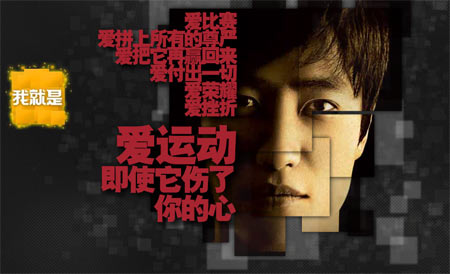
Now four years after, I felt the sadness watching him pulling out. Liu was not on camera immediately afterward, he issued an apology - it's not like he needed to. His apology came out the same time Nike tweaked its ad campaign featuring liu. The words on the poster read:"Love competition. Love risking your pride. Love winning it back. Love giving it everything you’ve got. Love the glory. Love the pain. Love sport even when it breaks your heart." I couldn't help but thought of the word: PR.

What about the "women likes to indulge to dubious relationships" part, you may ask? Well, isn't it obvious by now? The counterpart is that men are not courageous enough.

Related Content of This Rocking Post

Monday, August 18, 2008

Who is Liu Xiang

(1)
What a spectacle it must be when more than 90,000 collectively let out "ahh?" in astonishment.

No, it's not opening ceremonial group exercise, it was the reaction in the Bird's Nest when it was announced Liu Xiang dropped out the race due to injury. More jaws were dropped in front of millions of TV sets in China and around the world. They had seen Liu Xiong warming up; they had seen him at the starting block, seemingly grimacing in pain. They couldn't believe the drop-out.

Several minutes later, huge crowds began to file out, leaving the stadium half empty.

The reaction immediately began. Many couldn't accept the reality how he ended competition - on the starting block, some even suggested he should complete the course, even by walking to the end line. For the conspiracy theorists, they pointed to huge commercial interests behind the decision to pull out. Liu had been the face for numerous products in China. The admirers meanwhile poured out their sympathy and support for Liu, a CCTV reporter even called the pull-out a admirable decision. One had to be puzzled what was admirable in a dropout due to injury.

The speculation centered around the nature and extent of Liu's injury, and the media coverage leading up to the drama. Earlier signs indicated he was not in good shape. He withdrew from a meet in New York in May citing hamstring injury, and alleged purposely false-started at the Prefontaine Classic. He then skipped the European circuit, and did not appear at the opening ceremony. In the meanwhile, Chinese media had been giving a different picture. He reportedly posted a good time in test-run on the track of Bird's Nest. Just several days ago, he was said to run well within 13 seconds. Only on last Saturday, his coach cautioned Liu had a symptom of inflamed Achilles tendon, in injury that was said to first occurred six years ago and suddenly reemerged prior to the competition. That would be the official injury that did Liu in on the starting block of Olympics games. The drama stunned the whole stadium and a whole nation.

Among the bickering between Liu's fans and supporters and those who cast doubt why it ended with this dramatic fashion, it's important to remember that scrutiny was an understandable reaction when so much national pride and money were tied up with Liu. Even the American reporter James Farrows had commented:"But it would be natural and human if it were something more too: perhaps better not to try at all than to be captured forever on tape coming up short. It's hard to feel sorry for someone as rich and celebrated as Liu Xiang. But you can sympathize."

(2)
What to make of the Liu Xiang drama, or tragedy? I say get over it China.

It's unnatural, or even unhealthy, to place so high expectation and pressure on one athlete. It was too high an expectation to expect ANY short distance sprinter to repeat Olympics glory of four years ago. You just have to review Olympic history to see how realistic that is.

Too much had been made out of Liu's victory in Athens four years ago. Liu, as the first top Chinese athlete in sprinting had been a symbol of athletic capacity of Chinese, and even Asians. Many even held him as a proof that Asians are no less inferior to, say blacks, in printing athleticism. Sorry to burst bubble, but 110 hurdle isn't pure speed, technique plays a big part. And so what Asians are not as gifted in short track? Difference in muscle build up has been a reality. Black athletes have been dominating short track running from forever. The U.S. has been successful in track and and field due to precisely racial diversity of population and foreign imports. There is even research that suggests Jamaica sprinters' success - see Bolt and top three finish in women's 100m - is in part because they are naturally gifted due to gene in fast switch muscle fiber. It's neither true nor fair to place ethnic theories behind one athlete.

In America, there are similarly biased sayings such as "White men can't jump". Occasionally, there are white high flying dunkers to "prove them wrong". But frankly, several example of freakish athleticism of whites and bunch of examples of freakish athleticism of blacks prove nothing, nor does it prove anything. While "White men can't jump" remains an urban mystery, nobody seems to particularly care to de-mystify it.

In a commercial, Liu Xiang beams into the camera and asks:"I am Liu Xiang, who are you?" Yes, it's important to answer that question. Who is Liu Xiang? He is still the Olympics champion in Athens, the first Asian to get a gold in short distance track and field. And he should be remembered as such, regardless of whatever drama happened in Beijing. Who are we? We are just spectators. We can cheer on and feel the pride if he wins, but to place too much significance in his victory or failure is just too much. It's just another day an athlete pulls out of competition, dramatic or not.
...........................................................................

九万多个人异口同声“啊”是什么感觉?

不,这壮观情形不是在排演开幕式团体操,而是现场广播宣布刘翔已经退出比赛时全体观众集体地惊诧难以置信。中国和世界各地的电视机前还有数不清掉下来的下巴。

几分钟后球场观众走了大半。

评论马上炸开了锅。持阴谋论者有之,同情支持者有之,甚至认为刘翔走也要走到终点的也不乏其人,把退赛称作“伟大的决定”的也莫名其妙地存在,似乎退赛场景还不够戏剧化一般。

当我们看待各种评论漩涡时,应该说各种反应都是可以理解的。当一个人的体育成就被赋予这么多超出体育的意义,当一个人的成功与否被加以这么多的期望和压力,被和更广义的成功与否联系在一起,当一个运动员的受伤与否,受的什么伤什么时候受的伤,被象保护国家机密一样保护的时候,还有什么不能理解呢。当体育被过多得和商业和民族荣誉感联系在一起——这是实事——指责和洗不清也是正常的事。

醒醒吧,中国人。

集体得瑟什么呢。这种得瑟四年前就开始了。刘翔在雅典的胜利被认为不仅是民族的骄傲,甚至是中国人甚至说黄种人在短跑能力上不比别人差的证明。说实话,110米栏并不是证明单纯速度的项目,它需要的除了速度还有过栏技巧。更何况一个刘翔根本不能证明或反证什么人种的差异。一个体育怪才,刘翔,相对于一些体育怪才,同场竞技的黑人兄弟们,的胜利并不能说明任何问题。美国也流行一句话,White man can't jump (白人跳不起来)。 自从黑人在NBA高跳驰骋后,这句话也多少成为城市神话。偶尔也有出个厉害的白人扣篮者,但这些个例并不足以打破神话,也没有人特别在意要去证明或反证。

就算中国人确实在短跑上不如黑人又怎样呢?美国在田径上的成功很大程度上靠的就是人种的多样化和进口运动员(比如来自肯尼亚的长跑运动员)。某些差异本来就存在,有研究表明牙买加人肌肉纤维天然就占优势,但在Bolt出现前没有人相信这么高的人能够跑这么快。当那个中国运动员站在100米复赛跑道的时候,看他的体形就知道他跑不过同场竞技的人并不让人觉得奇怪。但这并不意味着我们不能为他跑出相对自己的好成绩叫好,更不意味着中国人就低人一等。

在一个广告中刘翔问:我是刘翔你是谁?确实,这是一个需要回答的问题。刘翔是刘翔,不管鸟巢戏剧化一幕的后面是什么,刘翔还是奥运会金牌获得者,还是第一个获得短跑项目金牌的亚洲第一人。如果你研究一下奥运历史的话,你会发现期望一个短跑项目的金牌获得者四年后卫冕从一开始就是多么超出现实的期望。而我们,只是看客,观众。我们可以为他的成功而自豪而欢呼,就像美国人可以为菲尔普斯的八块金牌而自豪欢呼。但是赋予竞技太多不相称的意义,滥词赞美或苛求指责,戏剧也就变质。

[附:伤]
5/31/08,刘翔退出纽约赛,理由为大腿受伤
6/8/08,在Eugene的Prefontaine Classic抢跑,有人称故意
随即放弃欧洲赛
8月,“腿伤已好,状态良好”
8/8,未参加开幕式,
8/15,“内部赛测出12.98,脚伤跟腱炎复发”
8/18,鸟巢起跑线上因伤弃赛

Related Content of This Rocking Post

Friday, August 15, 2008

Grab Them Golds

A quick look at the medal count standing, you find leading countries are United States, China, Australia, France, Russia, South Korea, Germany, Japan, Britain, and Italy rounding out the top 10, with the first two in a pack of significant margin. Ladies and gentleman, that's almost your list of G-8 with China as 'guest observer", with Aussies of Commonwealth standing in for their Canadian brethren thanks to their performance in the pool. Only the Koreans are not economically or politically as influential. Conspicuously missing are India and Brazil, two important emerging markets in the BRIC block that many thought of being on the short watch list of G8 expansion.

Some "angry elitist" in China have vehemently protested that the medals had little to do with them so they could hardly got into the spirit of the Games, except...venting. As far as netizens go, the western press talked about "angry youth", a name implying overt nationalism, they missed the other part of the story: for every radical nationalist there seemed to be an equally radical bunch who took the baton from whatever was criticized of China from the West and took it to another extreme level. The Chinese mockingly called them, most of whom never set a foot in the outside world, jingying - or "elite".

The criticizers pointed out that medals are worthless, because they were not representative of how athletic or fit the Chinese were. They had a point. But these games were never meant to be a gauge on how athletic or fit a nation was. Otherwise, Finland should have won the gold of fittest nation, with Canada not far behind. The leading country in medal count, the United States, is also the world's leading country in obesity. The Michel Phelps and Usain Bolts of the world are never meant to represent mere mortals like us, or even whether a sport is practice by the people. They are what they are, games, and competitions.

A member of Canadian Olympic committee was outlining the strategy to improve Canada's medal counts: ID talent, get them into the "system", etc etc, as I typed. Whatever "system" those athletes are in, those games are not only for the national glory, it's also about pushing personal limit, achieving the best. How can anyone not be touched and emboldened by those marathon women filing in the stadium after running 26 miles, battling extreme fatigue? "You not only became a champion," the person in the TV said, "but also found a better self."

..........................................................................

TV Scene one: Tennis, women's single semifinal. The crowd was raucus. Loud chants of "China Jiayou" and "Lina Jiayou" can be heard between plays, sometimes even before the play was over. Some Russian accented "Sa-fi-na~" could be heard streaking out too. Given the atmasphere of the Olympics, tameness wasn't bo be expected, but this crowd was clearly not of your typical French Open. Safina stringed a couple double faults. Maybe the crowd noise was getting to her a little bit, but she kept her cool. Then, Li na charged to hit a overhead. The collective "woo" in anticipation could be heard from crowd. Out of bounds! Li Na was noticablly annoyed, she turned her head to the crowd and cursed out a grumbled "shut up". The crowd went dead. Lest she forgot, she proved she was a member of the crowd too.

TV scene two: Rowlling, women's double skull. CCTV camera was focusing on the Chinese pair who was targeted as haing "gold potential". Cameras were so busy chasing gold potential events that an earlier pair event didn't got broadcasted live. Minutes later, the Chinese got only to the fourth. The ancor in the studio annouced:" It's regretful, but it's O.K., actually China won a silver unexpectedly in an earlier rowlling event." The tape began to roll. No embarrassed TV crew faces could be seen on screen.

Related Content of This Rocking Post